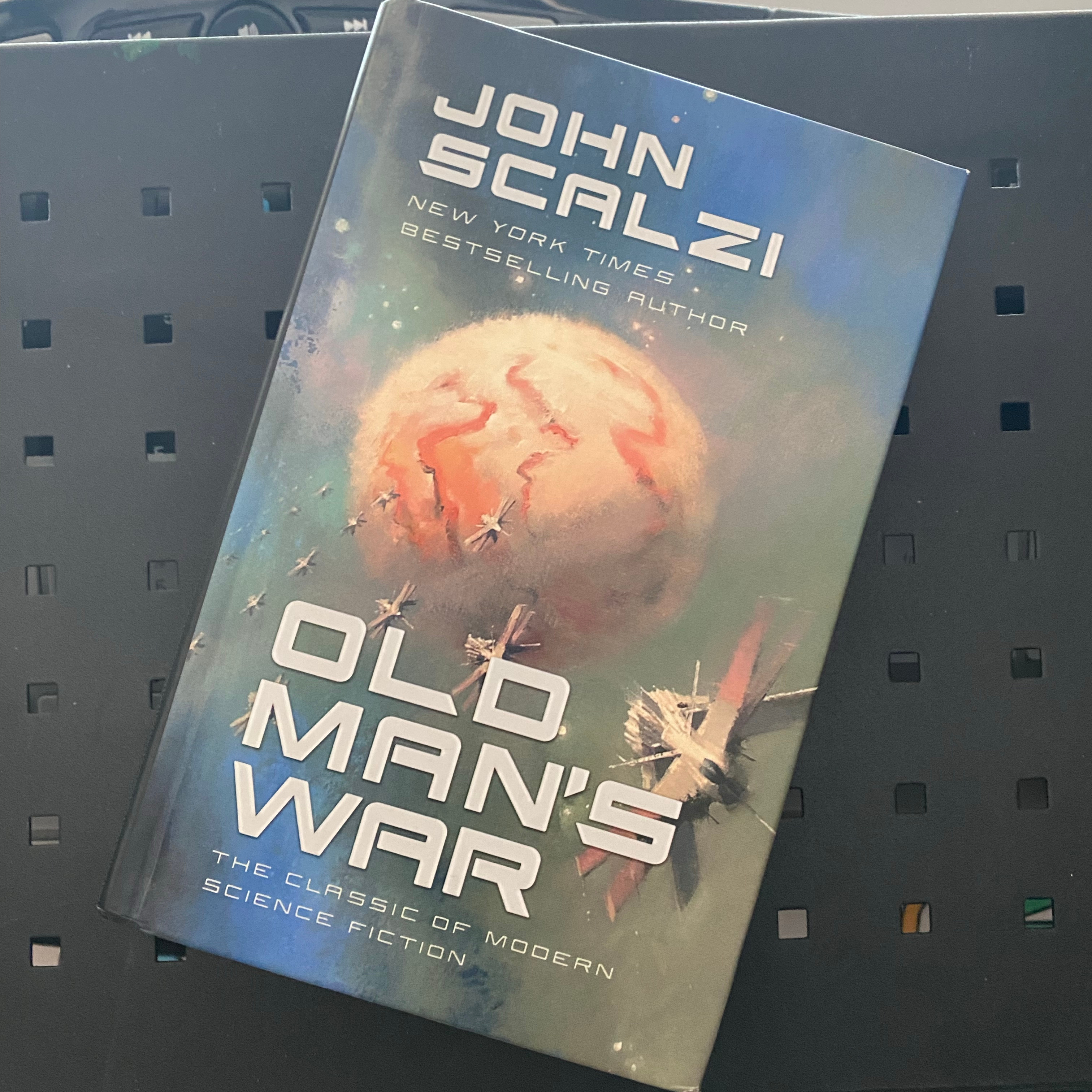
OLD MAN’S WAR by John Scalzi
“Part of what makes us human is what we mean to other people, and what people mean to us. I miss meaning something to someone, having that part of being human.”
This is the fourth book by Scalzi I’ve read (the first three being his Interdependency Trilogy), but arguably his most famous.
John Perry turned 75, visited his wife’s grave, then enlisted in the army. As always, the prose is fast and moves along, even when talking about complex sci-fi concepts. That’s Scalzi’s strong point, and something worth learning for any writer in my position.
His characters waste no time. They say what they want and what they feel. There’s no faffing about. The faffing is non-existent.
But at the core of this science-fiction war story set against the veil of uncharted space, is the very real story of what it means to be human. This is where I think Perry succeeds here more than in the Interdependency Trilogy. Not that I think it was poorly written, but I struggle to remember the characters as vividly as I do John Perry, a humble man from humble beginnings who turns the tide in the biggest war effort of all time. When he talks of his compatriots, you feel for them. You remember them.
I can see why it came highly recommended.
HUMAN TARGET by Tom King and Greg Smallwood

“Truth is, she’s not a superhero either.
She’s a god.
And all I can do is get down on my knees.
And pray.”
I recently finished Tom King’s run on BATMAN, alongside a who’s who of DC artists, putting out their best work. I could talk about it for years, what worked, what didn’t, why it soared in the highest of highs, and why even the lows are still leaps above what others have done with the character.
The one thing I could say is he tried to do too much over too long a period of time.
I’ve learned, much like everyone else, that King thrives in these 12-issue maxi-series, where he can plan out a beginning, a middle, and a definitive end. The BATMAN run was supposed to go for 100 issues, for crying out loud. MISTER MIRACLE, SUPERGIRL, and so on, are shining examples of this.
Christopher Chance is an obscure DC Comics character with little to no public awareness (even I wasn’t entirely sure of who we was when I started this), so of course, that means King can play around with him without worrying too much about “canon.”
He makes his living dying for clients, only to find out who was trying to kill them. Except this time it worked. He’s been poisoned, and has 12 days to find his killer.
And…it’s perfect. Near perfect. I can’t say too much else about it without taking way the thrill of the mystery, but you can see every panel, every scene, every carefully spoken line Chance makes to try to get one step closer to his killer, is something every writer can learn from. I’ve seen King’s scripts. There’s not much to them. He picks exactly the most important scene, the most important dialogue, and breaks it down to the base of what the character is thinking or lying about.
Does that make sense?
Smallwood’s art, pastel colors evoking a sense of film-noir with a retro feel, help move the story briskly and beautifully.
This, honestly, might be my favorite of King’s work so far as I explore more of his writings.
Thanks for reading,
Follow me:
Threads: @RobAcosta
BlueSky: @robacosta.bsky.social
Instagram: @robacosta
E-mail: robertmichaelacosta@gmail.com


 Fifth Draft
Leave a comment