*Note: Let us never forget that “Fifth Draft” is in reference to how many drafts I spend with a book before I deem it okay enough to start querying agents. The entire point of the ‘Fifth Draft’ category at the top of the website is to identify all the skills I’ve learned to help me become a published author now that that’s out of the way ON TO WRITING STUFFS*
I wished I wrote enough on here to have an extensive Fifth Draft slang, the lingo my most devoted readers would use when discussing my stuff. Years ago, I popularized (in my own mind and the site) the term “Stine Model Outline.” It was developed in my taking of the R.L. Stine Masterclass, to highlight how Stine outlines his books.
To keep it abridged, he says his outlines are 15-20 pages long, and they’re as complete as possible. He spends a week on the outline (to make sure it makes sense, characters follow through, and there’s a good middle). This outline allows him to see what he has, in turn allowing his editor to see what the book will be. Stine’s books, if you’re a child of the 90s you should know, are all plot-driven, with short chapters, easy-to-read words, and cliffhangers. The outlines demonstrates this, including lines of dialogue that can make it to the book, as well as being written in the style of the book.
This is the structure I’ve found that’s worked best for me.
I’ve written (*thinks to himself*) three books to completion using this model. That ignores the stop-start pushes I’ll give to some story ideas, only to find they fade out in the outline process, meaning they don’t carry enough weight to be a full book. It’s been helpful in my own writing prospects. Create the outline, detail the chapter, add in dialogue, and build on it. Never start from scratch. The book comes from this as you copy and paste it over to the next thing, then keep adding and taking away stuff.
Which leads me, unfortunately, to my next point.

Akira Toriyama, famed mangaka and creator of the DRAGON BALL franchise, passed away at the beginning of March. We only found out about it March 8. It still hurts. Honestly, it’s one of the most devastating losses I’ve experienced. Something I’m sure I’ll be processing for many more months to come, if not forever.
What makes this loss all the more hurtful (and personal *side-eyes the universe*) was that I had only recently started studying the man, Toriyama Sensei, as a creator. I’d say my input on writing and the art of writing/creating has gone up tremendously this past year, boosted by my attendance in the Bendis and Soma JINXWORLD MASTERCLASS. What I noticed Bendis does, regularly, is reference “the greats,” as I’ll call them. Filmmakers and authors and writers who greatly influenced him at all stages of his life.
I thought, “That’s cool… maybe I should identify the people who influenced me in the same way and study them.”
So, I did. I started with Toriyama.
A big help have been the videos by the YouTube channel “Totally Not Mark.” While they are recaps of the entire DRAGON BALL series, it’s not just “this big fight happens and then THIS big fight happens.” No, they’re done with reverence for the material, explaining and elaborating on character notes and writing styles like you were in a college literary class.
This, more than anything, helped me examine Toriyama’s writing style and I noticed something: He’s really, really good at making it up as he goes.
This isn’t new. There’s plenty of published material out there, interviews with Toriyama’s editors and the man himself, that explains he doesn’t really DO long term planning in regards to his stories. Which is crazy, when you consider DRAGON BALL, all of it, the complete story, was 42 volumes long.
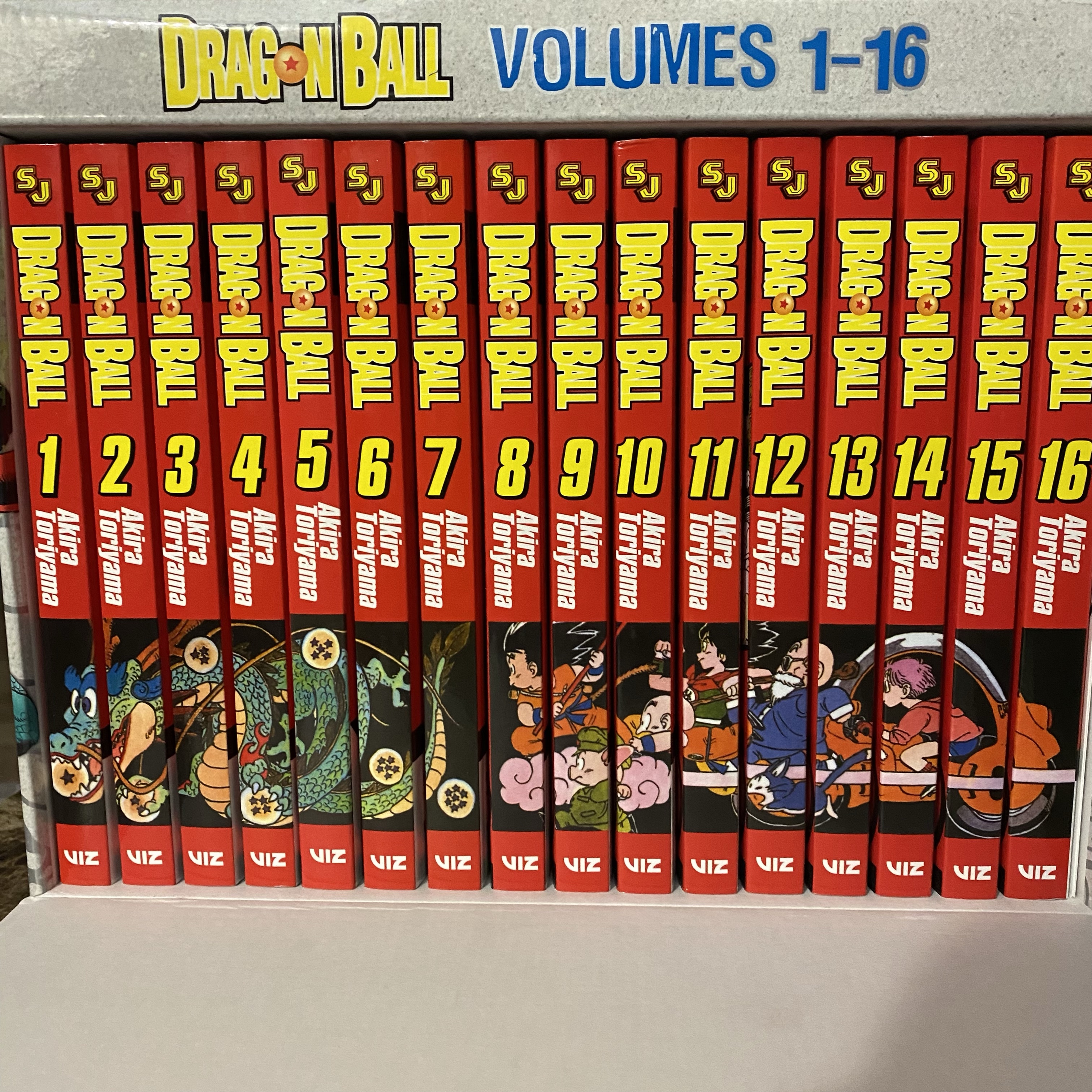
The first section, called “OG Dragon Ball” by the fan base, is 16 volumes. This makes up the first 1/3 of the adventures of Goku and friends, before it reaches a natural stopping point. Seriously, you could read JUST these 16 volumes and feel like you got an entire story. Start to finish. A complete arc for everyone involved. That wasn’t the case, though, and Toriyama kept going.
And his work habits never changed. A notoriously lazy fellow by his own admission, his ACTUAL work day would demonstrate a serious minded artist, someone who understood the mission.

He worked HARD to make DRAGON BALL a reality. So if he didn’t plan things out, how did he do it?
I want to reference the picture up above, the one showcasing the sixteen volumes of the original Dragon Ball run. Those 16 volumes can be divided into two perfect arcs, volumes 1-9 and volumes 10-16, an almost perfect split. Volumes 1 through 9 each bleed into each other, something Toriyama was another expert at. One story/saga ends, and then characters and plot points lead into the next story/saga, he introduces new elements, which then lead into the next. It’s a great way to make the world of Dragon Ball feel epic and real and connected.
Then there’s a break, you could honestly argue, in the middle of volume 9, but let’s say the time-skip that comes at the end of volume 9 is the actual breaking point. Volumes 10-16 pick up the pattern he established. We begin a new saga/story, stories and characters are introduced, these lead into the next story and saga, which then carry over, setting up the next…and so on.
And to think he did all of it WITHOUT ANY PRIOR PLANNING OR FORETHOUGHT. Sure, once he reached a point in the story where he realized, “Oh, this is a good way to wrap this all up,” you can tell because he accelerates towards that finish. But everything else? Week to week? Page to page? He didn’t know.
He had that Toriyama Instinct. That innate feeling of, “What does the story need? Ah, the story needs THIS.”
I know I’m not alone on this island of querying writers, people trying to get their books, their stories, out there to be published. To be paid for a living to do this. I study. I read to learn how to write. I know when a story works. I feel it. I know when a story doesn’t work. I feel it more especially in my own writing as opposed to professional stuff that gets made.
I got a project, codenamed Project CLOUD, that’s ready to go into its first draft. Its inspired by a lot of how Toriyama came up with the idea of Dragon Ball. You could even argue it’s my own homage, my salute, to the spirit of Dragon Ball. I have an outline with the first 30 chapters plotted out (Don’t worry. It’s a Stine Model outline for middle grade readers. Short chapters, cliffhangers, and lots of fun.) but the final 20? I got an idea for how it goes, how it’ll end.
But maybe I’ll trust my Toriyama Instinct, the idea that I know what story needs and can figure it out on the go, like one of the most successful manga creators of all time, in his prime, working day to day, week to week, to craft one of the most beloved and memorable stories ever.
Trust your Toriyama Instinct.
Thanks for reading,
Follow me:
Threads: @RobAcosta
BlueSky: @robacosta.bsky.social
Instagram: @robacosta
E-mail: robertmichaelacosta@gmail.com


 Fifth Draft
Leave a comment